
 Netherlands
 Belgium
 Denmark
 Germany
 France
 United States
 Austria
 UK
 Spain
 Italy

Agents know who they are answering for
A whisper message tells the agent which client or line the call is for, before the conversation starts.
Whisper messageA national campaign goes live and more people call at once than there are agents free. An answering service picks up for several businesses, each with its own number, greeting and call flow, while your team works from one dashboard. Outside office hours the calls go to another team, without anyone having to switch anything over. That is what our call center phone system is built for.

A whisper message tells the agent which client or line the call is for, before the conversation starts.
Whisper message
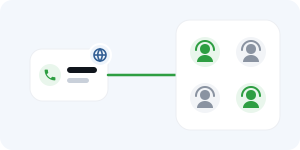
Calls go to the agents who are signed in. Whoever takes a break signs out for a moment and the others take over.
Team dashboardThis is how we set up an answering service that picks up for several clients. An in-house inbound call center uses the same call flow with a single number, and you can leave parts out or add them at any time.
Every client of your answering service gets its own number with its own welcome message, so the caller hears right away that they have come to the right place.
“Welcome to Dawson Plumbing & Heating.”
With a phone menu (IVR) the caller chooses the department themselves, so they are not transferred needlessly and reach the right agent sooner.
“Press 1 to request a repair, press 2 to book an appointment.”
When all agents are busy, the caller joins the queue and hears a waiting message until someone is free, so there is no busy signal and no call gets lost.
Agents sign in on the team dashboard when their shift starts, so the routing always knows the agent availability. Incoming calls ring whoever is available, in the order you set, and if someone does not answer, the call moves on to the next person.
Before the call is connected, the agent hears a short whisper message with the name of the client that was called. They answer with the right company name, so the caller does not notice they have reached an answering service.
With time-based routing calls go to your client’s own team during working hours and to your agents outside office hours. You set this up once, and after that the routing follows the clock.
Agents work from home, from different cities or even from different countries, and all they need is a phone. You add or remove agents at any time without changing a single number.
No extra hardware or software. Calls are forwarded to the agent’s phone, or to your existing phone system or SaaS tool if you prefer. That way our numbers can also act as a backup or overflow layer alongside a setup you already have.
We run our own intelligent IVR platform and are a licensed telecom operator in 14 European countries. When you need a change or something does not work, the same team that runs the platform looks into it and makes the change, which matters when your call center handles hundreds of calls a day.
A new call flow for a client, changed by our own team.
The people who run the platform handle it themselves.
Call queues, the phone menu, whisper messages, the team dashboard and call recording with AI transcription all come with the Customer Service plan (up to 8 people): €49 per month. For a larger team, an answering service with a number for each client or your own IVR server, we plan the setup with you in one conversation.

Want to talk it over first?
Our team helps you with numbers and voicebots in each of our countries. Call us or use the contact form.
Go to the contact form → From any country +31 85 400 5588It is the telephony behind a team that answers incoming calls: the phone numbers, the phone menu (IVR), call queues, call routing to the agents who are available, and recordings. Ours runs on our own platform, so agents can answer on a mobile, a landline or a softphone, in one office or from home.
Yes. You set a threshold: once more than that number of callers are waiting, new calls go to the overflow team automatically. Callers below the threshold stay in the queue with a waiting message until an agent is free.
Yes. Our statistics panel breaks call volumes down by number, so you can show each client how many calls were handled and invoice them accordingly. If you need it, we can also invoice each client separately.
A call center phone system. We supply the telephony layer: phone numbers, call routing, call queues, phone menus and recordings. If you already use call center software such as a CRM or helpdesk, you connect it to our platform through the API or a webhook, or keep using it alongside our numbers as a backup or overflow layer.
Yes. Agents sign in on the team dashboard when their shift starts, and calls go to whoever is available. You add or remove agents without changing a number, and nobody needs to come into an office.
The agent hears a short message with the name of the company the caller dialed, just before the call is connected. They answer with that company name, so the caller does not notice they have reached an answering service.
Yes. Porting is free and takes at most five business days. Meanwhile your numbers keep working with your current provider, so your callers do not notice the move.
Calls go to a backup location, an external team or a partner call center, following rules you set in advance. The rule switches over when the condition you set is met, for example nobody answers within 30 seconds or your location cannot be reached because of a power or network outage. Once your main location is back, calls follow the normal routing again.
Yes. Every call can trigger a webhook that sends data to your CRM, helpdesk or ticketing system in real time. Through the API you also get call statistics and number management for your own integrations.
Within one business day. That applies to toll-free, national and local phone numbers alike; if we need to check your address, it can take a little longer. Wherever your customers are, in one country or several, we forward the calls straight to your call center.
No. We are a licensed operator in 14 European countries and supply international phone numbers in many other countries, the US included, through partner carriers, on our own platform. We handle the numbers, the paperwork and the routing, and you handle the calls. Before you start, we check with you which address and number rules apply in each country.
Yes. You can record incoming calls selectively to log orders, check compliance or train agents, which helps the customer experience in your contact center. With AI transcription, which you switch on in the dashboard, recordings become searchable text, so you can review calls faster and spot problems sooner. Only the account administrator can listen to recordings.
Yes. If your call center has its own developers, you get your own IVR server as a custom solution that your team programs as it wants: the call flow logic, your own scripts, real-time lookups during a call and links to any API or database you use. We supply the infrastructure, the carrier connections, the API integrations and the support, and your developers build on top of that.
Yes. If a client wants an AI voicebot that handles the first questions, or one that qualifies leads before they reach an agent, we build it. The voicebot costs €49 a month plus €0.35 per minute it talks, on top of Phone System (€25 a month), and is usually live within two business days.

Our team helps you with numbers and voicebots in each of our countries. Call us or use the contact form.
 European Union
GDPR-compliant · data in the EU
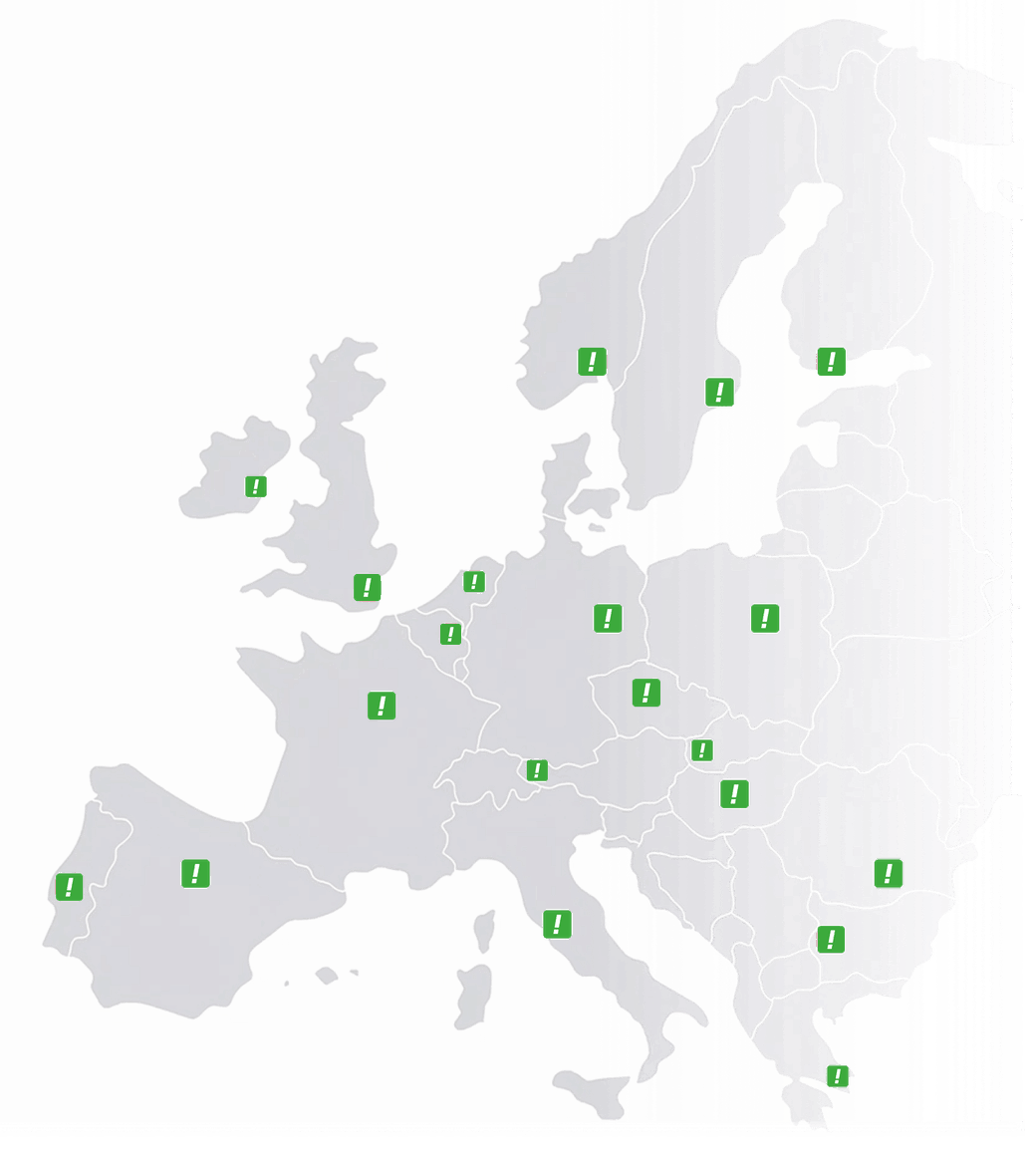 Licensed in 14 European countries