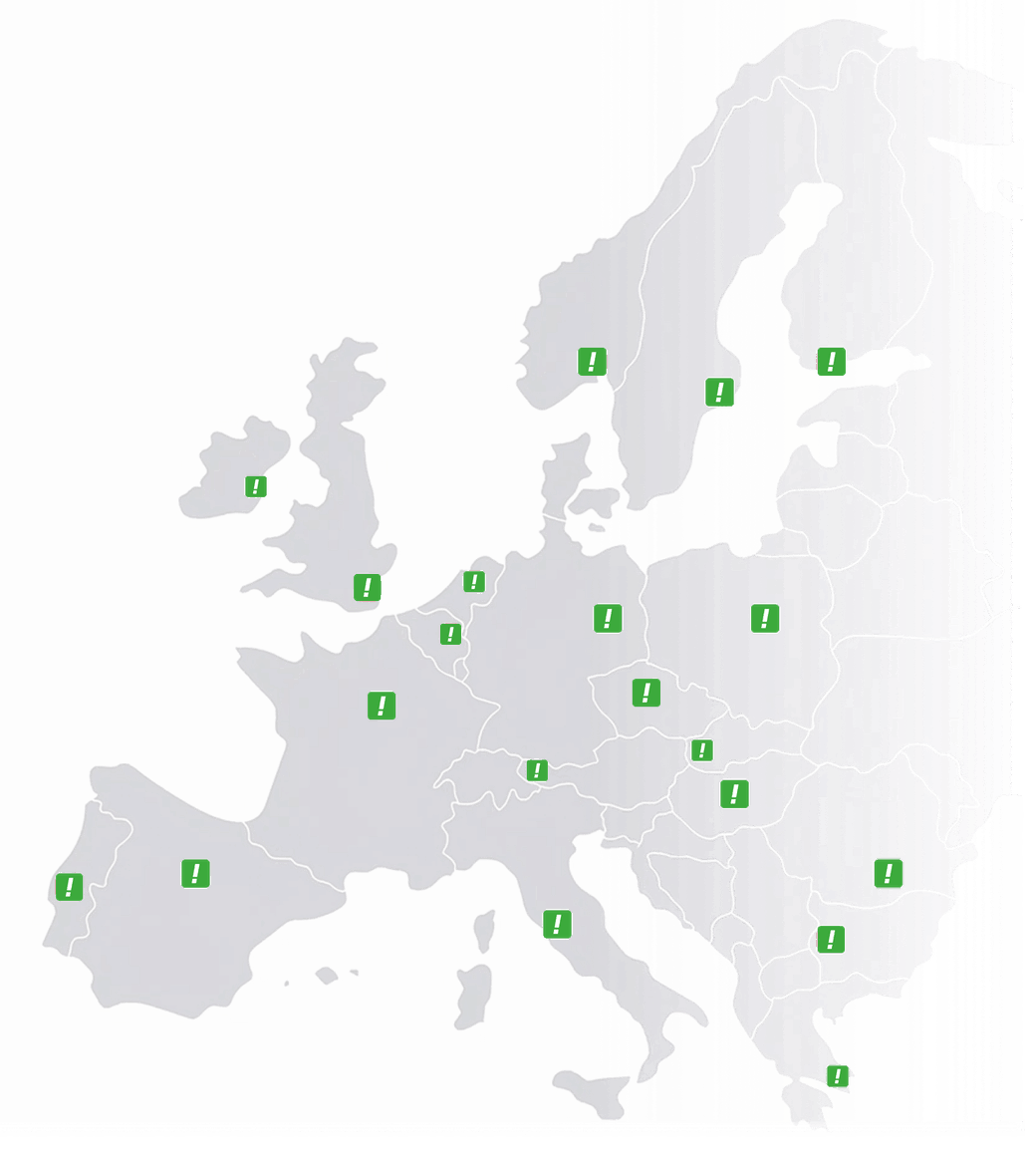
Netherlands
 Belgium
 Denmark
 Germany
 France
 United States
 Austria
 UK
 Spain
 Italy

A toll-free number is a phone number that is free to call for the caller. The business that owns the number pays for the call instead. In the United States you know them as 800 numbers, in most European countries they start with 0800. Customers see them on websites, packaging and invoices, and they call them without thinking about the cost.
This guide explains what a toll-free number is, how toll-free numbers work, which prefixes they use in different countries, why most of them only work inside their own country, and what a toll-free number costs your business.
What is a toll-free number?
A toll-free number is a telephone number with a special prefix that tells the phone network the call is free for the calling party. The caller pays nothing, from a landline or (in most countries) a mobile. The business that owns the number pays the call charges, usually per minute.
The idea comes from the United States, where toll-free numbers have been in use for decades. Famous examples are numbers that spell a word on the keypad, such as 1-800-FLOWERS. European countries followed with their own toll-free ranges, such as 0800 in the Netherlands, Germany and the UK.
A toll-free number is not tied to a city or region. That makes it different from local numbers with an area code, and it is one reason businesses with customers across a whole country choose one. Large companies use toll-free service for their call centers, but small businesses use toll-free calls just as much, for an order line or a support line.
How toll-free numbers work
A toll-free number is not a phone line. It is a number in the national numbering plan that points to a destination you choose. When a customer dials it:
- The call enters the phone network in the caller’s country. The network recognizes the toll-free prefix and does not charge the caller.
- The call reaches the provider of the number, which looks up where calls to that number should go.
- The provider routes the call to your destination: a mobile, a landline, a desk phone, a phone menu or a whole team.
- The business pays for the call, at the per-minute rate of its toll-free number.
On our platform, step 3 is where the features sit. Calls to your toll-free number can hear a welcome message, go through a phone menu (IVR), wait in a call queue and ring on the phones of your team in the order you choose. We forward the calls over the normal phone network to mobiles and landlines, so they never depend on an internet connection.
Toll-free prefixes by country
Every country has its own toll-free prefix. These are the most common ones:
| Country | Toll-free prefix | Format |
|---|---|---|
| United States and Canada | 800, 833, 844, 855, 866, 877, 888 | +1 800 xxx xxxx |
| Netherlands | 0800 | 0800 xxx xxxx, for example 0800 235 3227 |
| Germany | 0800 | 0800 followed by the subscriber number |
| United Kingdom | 0800, 0808 | 0800 xxx xxxx |
| Belgium, Austria, Switzerland | 0800 | 0800 followed by the subscriber number |
| France | 0800 to 0805 | 0800 xx xx xx |
| Spain | 900 | 900 xxx xxx |
| Italy | 800 | 800 xxx xxx |
| Poland | 800 | 800 xxx xxx |
| Ireland | 1800 | 1800 xxx xxx |
The Dutch example, 0800 235 3227, is our own toll-free number in the Netherlands.
In the United States and Canada, all seven prefixes work the same way. The original 800 range ran short, so 888, 877, 866, 855, 844 and 833 were added over time. For callers there is no difference between a toll-free number with 800 and one with 833.
Why toll-free numbers usually only work in their own country
A toll-free number can normally only be called from inside its own country. A German 0800 number works only from Germany, a Dutch 0800 number only from the Netherlands, and a US 800 number is meant for callers in the United States.
There are two practical reasons. Phone networks abroad usually don’t route calls to another country’s toll-free range. And the cost of a call that starts abroad cannot easily be charged to the business that owns the number, because the toll-free model assumes a domestic call.
For a business with customers in several countries, this has a clear consequence: you need one toll-free number per country. A German customer calls your German 0800 number, a customer in Spain your 900 number, and a customer in the United States your 800 number. All of them can ring the same team.
International toll-free numbers
So what about international toll-free numbers? In practice, the reliable way to offer free calls in several countries is a set of national toll-free numbers, one per country, all routed to the same destination. On our platform that is one dashboard with several numbers, and each number can have its own greeting in the local language with our text-to-speech assistant, so German callers hear a German welcome message and French callers a French one.
The ITU, the UN agency for telecommunications, also has a global toll-free range (+800, the Universal International Freephone Number), but which countries and networks can reach those numbers varies, so most businesses use national toll-free numbers instead.
If calls should be answered in the caller’s own language, a phone menu per country or our AI voicebot, which speaks 99 languages, helps your team handle international callers.
Why businesses use a toll-free number
- No cost barrier for the caller. Customers call more easily when the call is free, which matters for sales lines, order lines and customer support.
- A professional image. A toll-free number looks established, also for a small business or a startup, and it signals that you want customers to call.
- National reach. One number for the whole country, not tied to an area code, so it works for a business with customers in different cities and regions.
- Easy to remember. Short or memorable numbers, and a vanity number in the United States, work well in marketing campaigns, on billboards, in ads and on marketing materials.
- Helplines and support teams. Service lines, product hotlines and healthcare lines often use toll-free numbers so nobody hesitates to call.
- Tracking. A separate toll-free number for a campaign shows how many calls it brings in.
Toll-free number vs local number
A toll-free number and a local number serve different goals, and many businesses use both.
| Toll-free number | Local number | |
|---|---|---|
| Cost for the caller | Free | A normal call |
| Who pays for the call | The business, per minute | The caller |
| Linked to | The whole country | A city or region (area code) |
| Callable from abroad | Usually not | Yes |
| Best for | Sales, support, campaigns | Local presence, regional customers |
A local number with a familiar local area code builds trust with local customers and can also be called from abroad. In the United States, toll-free numbers were originally popular because a call to another state was a long distance call that the caller paid for; a toll-free number moved those long distance charges to the business. A toll-free number removes the cost for the caller but is usually domestic only. In several countries there are also national numbers, such as 085 in the Netherlands, which are not linked to a city and cost the caller a normal call.
Toll-free numbers in the United States
US toll-free numbers fall under rules of the Federal Communications Commission (FCC). Each toll-free number is managed by a so-called Responsible Organization (RespOrg), which records in a central database which provider routes the number. Because of that system, a US toll-free number is portable: you can move it to another provider and keep it.
The FCC also prohibits hoarding and selling toll-free numbers, and the most attractive vanity numbers have been taken for years, so a good word is rarely still available.
We are not an operator in the United States: US numbers come through a partner carrier and arrive on our own platform. A US phone number, local or toll-free, registers on your business address anywhere in the world, so you don’t need a US office or a US company. Calls from your US customers can ring on your mobile or landline in Europe; that forwarding has its own per-minute rate, which we quote with the number.
Toll-free numbers in the Netherlands: the 0800 number
In the Netherlands, 0800 numbers were added to the national numbering plan on 1 January 1997. Today the plan is managed by the Netherlands Authority for Consumers and Markets (ACM). Dutch 0800 numbers are issued per individual number, not in blocks, and they are free for the caller from landlines and mobiles.
A Dutch 0800 number is registered with the ACM in your company’s name, on a business address in any country. We guide you through the application free of charge. The ACM usually needs two to three weeks to approve the application, and after that we need about five business days to activate the number.
Toll-free numbers and your phone system
A toll-free number works with the phone system you already have. We forward the incoming calls to your current phone numbers, your phone system, or both, so you don’t need new hardware. Many businesses add a toll-free number next to their existing business number: the local number for existing customers, the toll-free line for new ones and for campaigns. Both can ring the same team, and the call statistics in the dashboard show the incoming and missed calls of each number, so you see which number brings in which calls.
What does a toll-free number cost?
For the caller, nothing. For the business, there are two parts:
- The number itself. With CallFactory, a toll-free number in any country is €49 a month or €490 a year, with every Customer Service feature: phone menu, call queue, call recording, voicemail by email and call statistics.
- The calls. Calls to a toll-free number have their own per-minute rate, because you pay for the call instead of the caller. The rate differs by country, and in many countries calls from mobiles cost the business more than calls from landlines. We quote the rate on request.
Prices exclude VAT where it applies. All plans are on the pricing page.
How to get a toll-free number
- Choose the countries. One toll-free number for each country where your customers are.
- Tell us where calls should ring. On which mobiles, landlines or desk phones, and in which order.
- We check the rules and register the number. Some countries ask for documents or a local address; we check that with you before you order.
- The number goes live. In most countries within one business day; a Dutch 0800 number takes longer because of the ACM approval.
Already have a toll-free number with another provider? You can port it to us free of charge, in at most five business days, and the number keeps working in the meantime. Our numbers are for calls and don’t receive SMS; for WhatsApp Business you choose verification by voice call.