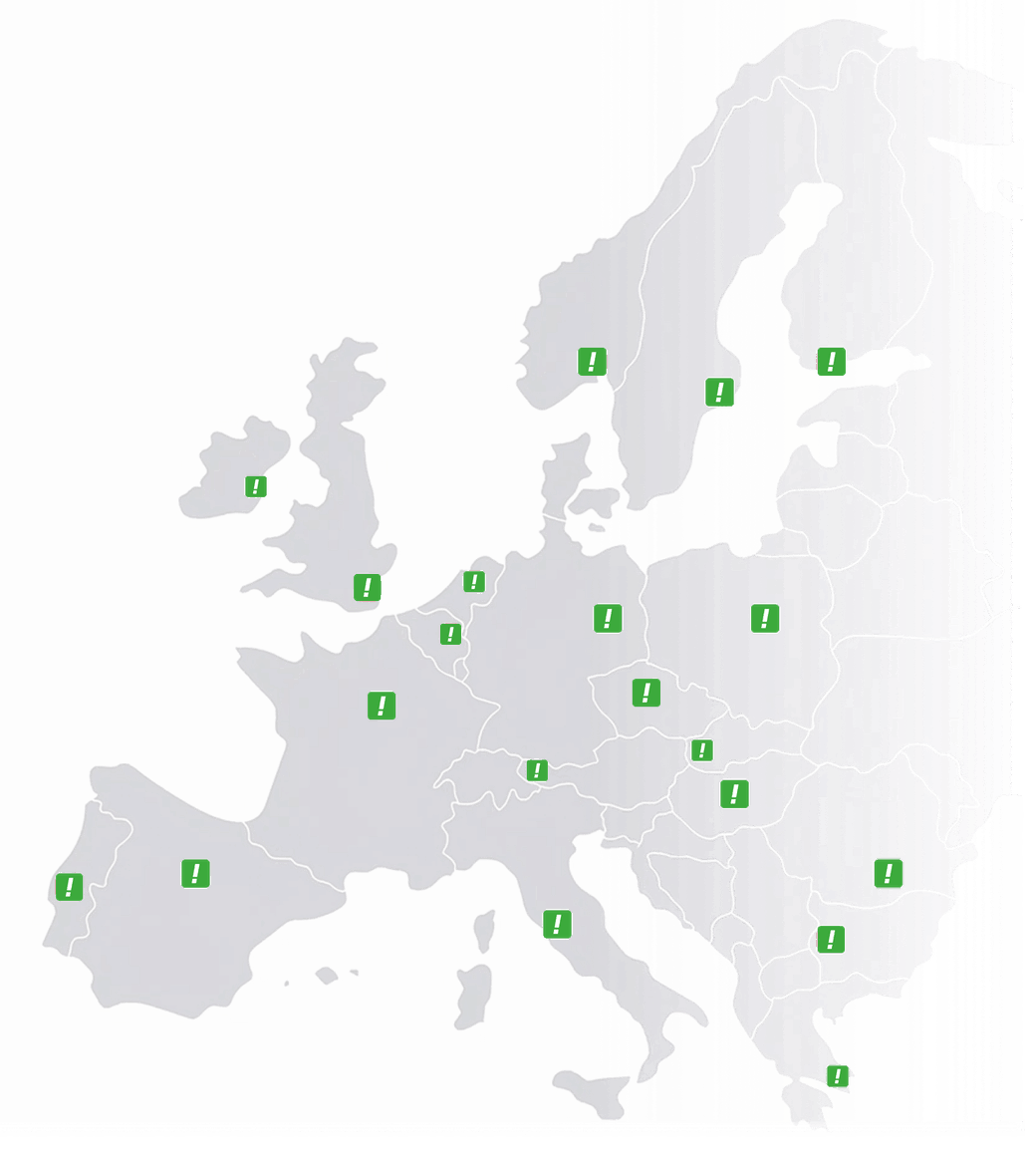
Netherlands
 Belgium
 Denmark
 Germany
 France
 United States
 Austria
 UK
 Spain
 Italy

A PBX is a business phone system: the system that distributes incoming calls to your business number over the phones of your team, lets colleagues call each other internally and makes sure everyone calls out with the same business number. A PBX used to be a cabinet in the server room. Today, most PBX phone systems run as software in the cloud, so you no longer buy hardware but pay a monthly fee.
In this article you read what PBX means, how a PBX phone system works, how a traditional PBX, an IP PBX and a cloud PBX differ, and what to check when you replace your PBX. If you are looking for a phone system for your business right away, see our cloud phone system.
What is a PBX? The meaning of private branch exchange
PBX stands for private branch exchange. The “exchange” is the switch where calls are connected, the “branch” is the part of the public telephone network that serves one organization, and “private” means the switch belongs to the business, not to the phone company. A PBX is a private telephone network inside a business, with a limited number of external lines to the public switched telephone network (PSTN), the public phone network that carries ordinary phone calls.
You also see the term PABX, private automatic branch exchange (sometimes written as private automated branch exchange). The “automatic” dates from the time when operators connected calls by hand on a switchboard; a PABX did that automatically. Since every PBX system now works automatically, PBX and PABX are used as synonyms, just like “business phone system” and “office phone system”.
What does a PBX phone system do?
A PBX sits between the public telephone network and the phones of your employees. It handles incoming and outgoing calls and decides what happens to each call, so not every employee needs their own phone line. The main tasks are:
- Call routing. When a customer calls your main number, the PBX automatically routes incoming calls to the right phones: all at once, one after another or in turn.
- Internal calls. Colleagues call each other with a short extension number, without the call going out to the public network.
- Outbound calls. Everyone calls out with the business number, so the customer sees your business phone number and not a private mobile number.
- Call transfers and call forwarding. A call goes from reception to the right department, or to a mobile when nobody at the office is available.
- Phone menu and queue. With a phone menu (IVR), also called an auto attendant, callers choose the right department themselves, and a call queue holds callers when everyone is busy.
- Business hours and voicemail. Outside business hours, callers hear a message or leave a voicemail.
Types of PBX phone systems: traditional PBX, IP PBX and cloud PBX
There are three main types of PBX phone systems. The difference is where the PBX runs and how calls travel.
Traditional PBX (on-premises PBX)
A traditional PBX is a physical phone system at your own location, usually a cabinet in a server room or closet. The desk phones are wired to the PBX, and the PBX connects to the public network over physical phone lines: analog lines (plain old telephone service) or digital lines such as ISDN (integrated services digital network). Many countries are now switching these legacy systems off. You buy the hardware, have it installed and pay a technician for maintenance and every change. If you want an extra phone or a new call route, someone has to come to the office.
IP PBX
An IP PBX uses the internet protocol instead of traditional phone lines. Voice travels as digital data over your network, and IP phones register with SIP, the session initiation protocol. The PBX is a server or software that still runs at your own location. Calls to the outside world usually go over a SIP trunk, a connection from a provider that links your PBX to the public network. You need less cabling, but management, updates and security remain your responsibility or that of your IT partner.
Hosted PBX (cloud PBX)
With a hosted PBX, also called a cloud PBX or virtual PBX, the phone system runs on the platform of an external provider. Because a hosted PBX system runs in the cloud, it is not tied to one office. You have no PBX hardware on site, only phones and an internet connection. You change settings such as call routing, the phone menu and business hours yourself in a dashboard in your browser, and the provider takes care of maintenance, updates and the connection to the telephone network. You pay a monthly fee instead of a large investment up front.
| Traditional PBX | IP PBX | Cloud PBX | |
|---|---|---|---|
| Where the PBX runs | Cabinet at the office | Server at the office | Provider’s platform |
| Connection to the outside | Phone lines | SIP trunk | Through the provider |
| Costs | Purchase plus maintenance | Purchase, licenses plus trunk | Monthly fee |
| Changes | Technician | You or your IT partner | Yourself, in the dashboard |
| Remote work and several offices | Difficult | Possible, with network work | Standard |
PBX and VoIP: what is the difference?
PBX and VoIP are often mixed up, but they are different things. VoIP (voice over internet protocol) is the technology that sends voice over the internet. A PBX is the system that decides where a call goes. An IP PBX and a cloud PBX use VoIP; a traditional PBX does not.
One detail matters for your reachability. With many cloud PBX services, every call goes over the internet, even when it has to reach a colleague’s mobile, the same weak spot that explains why a VoIP app misses calls. If the internet connection fails, the business cannot be reached. With CallFactory, the platform chooses the route for each device: the internet for desk phones and softphones, and the mobile network for mobile phones. So the mobiles in your team keep ringing when the office internet goes down. Read more about business calls on your mobile.
Features of modern PBX systems
Modern PBX systems do more than distribute phone calls. On our cloud phone system, these include:
- Calls on every device. Colleagues answer on a desk phone, a softphone on their laptop or their mobile, all on the same business number.
- A team dashboard. In the team dashboard colleagues set themselves available or away, and the next call follows that choice.
- Call recording and statistics. In the Customer Service plan you record incoming calls for training or proof, and the dashboard shows incoming and missed calls.
- Integration with your software. Through our API you connect the phone system to your CRM, so routing can depend on who is calling.
- Welcome message and voicemail. Every caller first hears a greeting from your business, and outside business hours they can leave a message, which is sent to your email.
Benefits of a cloud PBX
Most businesses that replace their PBX now choose a hosted PBX, and for small businesses it is usually the simplest route. The reasons:
- Low costs up front. You buy no expensive equipment and pay no technician for every change; you pay a fixed amount per month.
- Flexibility. Your number is no longer tied to one office. Colleagues answer wherever they work.
- Multiple offices. Each office can have its own team and, if you want, its own local number, while you manage everything in the same dashboard. That works across countries too: a local number in Germany and one in Spain, both ringing on the same team.
- Scalable. Adding a new colleague is a setting in the dashboard, with no extra lines or cabling, up to 50 team members on one number.
- No IT staff needed for maintenance. The provider keeps the platform up to date and secure, so you only manage your own settings.
An on-premises PBX can still fit, for example if you have a recent PBX that will last for years, or if your organization wants to manage everything itself. In that case we can forward calls from our numbers to the PBX you already use.
What does a PBX cost?
It depends on the type. A traditional PBX or IP PBX needs an investment in hardware or server licenses, installation and maintenance, plus the cost of phone lines or a SIP trunk. With a hosted PBX provider you pay a monthly fee, usually per user or per plan, and sometimes call charges. Our comparison of per-user and per-minute pricing shows how these models add up.
With CallFactory you pay per plan, not per device. The Phone System plan costs €25 a month or €250 a year for up to 2 people and includes your choice of ring order, business hours, desk phones and softphones and the team dashboard. If you also want a phone menu, a call queue and call recording, choose Customer Service at €49 a month or €490 a year for up to 8 people. For more people we make a custom plan. On local and national numbers in the 14 European countries where we are licensed, calls are included with normal use. All prices are on our pricing page.
What to check when you replace your PBX
When you replace an old PBX, these questions help you choose the PBX provider and phone system that fit your business:
- How many people and offices must be reachable? That decides which plan fits and whether each office gets its own number.
- Can you keep your existing numbers? With us, porting your number is free and takes at most five business days, so customers keep calling the same number.
- What happens when the internet fails? Ask whether calls then go to a mobile, and whether that call travels over the internet or the mobile network.
- Can you keep your current phones? Any SIP desk phone works on our platform, whatever the brand, so a move rarely means new hardware.
- Who runs the platform? Ask whether the provider runs its own platform. That decides who you talk to when something does not work.
CallFactory has been a telecom provider since 2001, is a licensed operator in 14 European countries and runs its cloud phone system on its own platform. Every plan has a free 7-day trial, so you can see how the phone system works for your business before you pay.