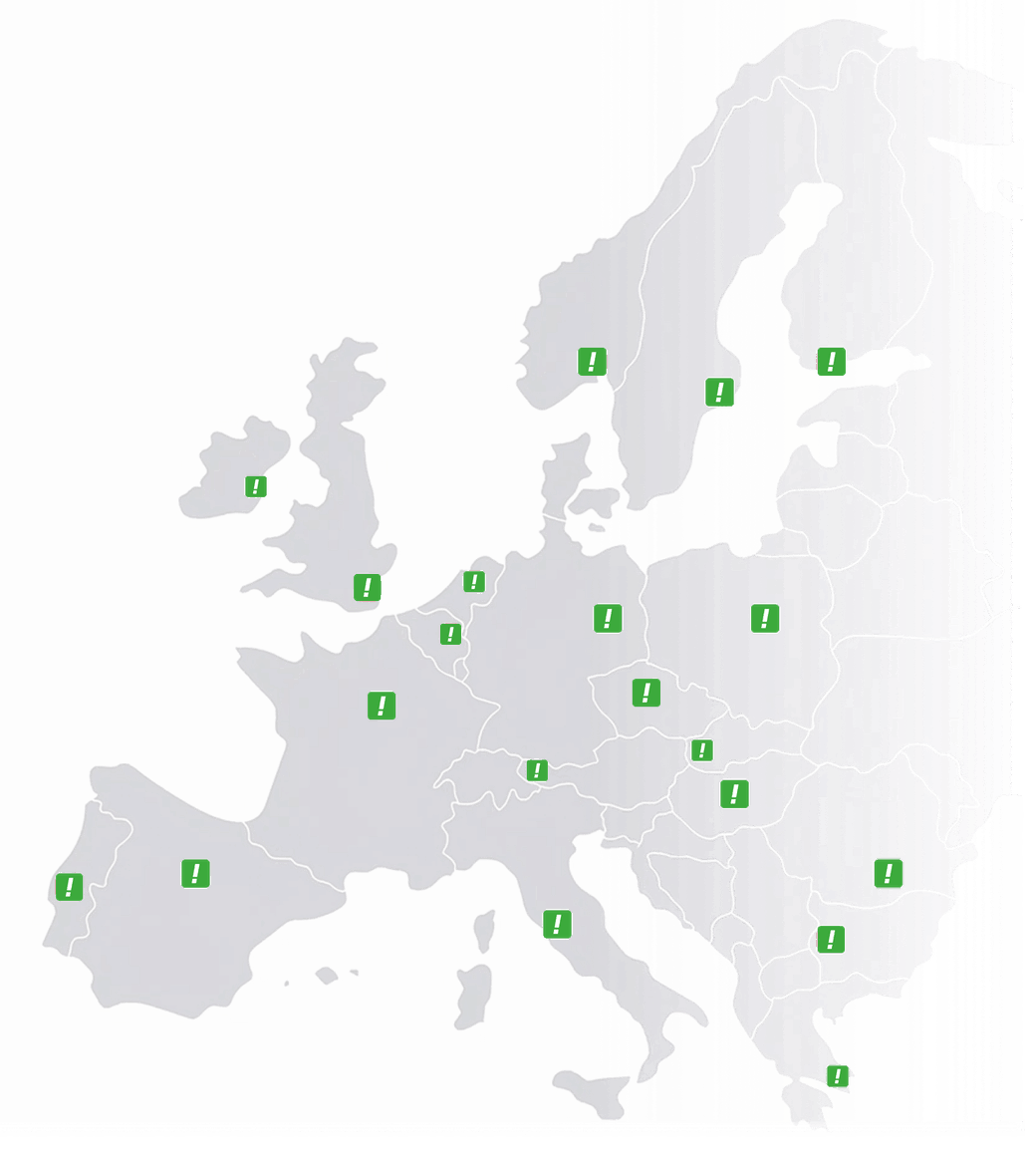
Netherlands
 Belgium
 Denmark
 Germany
 France
 United States
 Austria
 UK
 Spain
 Italy

We regularly hear from businesses that want a more reliable way to receive their incoming business calls. Most of them use a VoIP app on their mobile to take calls on their business number, and calls go missing. Customers say they called but nobody answered, while the phone never rang and showed no missed call. That does not surprise us. This article explains in plain language why a VoIP app misses calls and how you get your business number on your mobile without that risk.
What a VoIP app for your business phone does
VoIP means voice over internet protocol: the call travels as data over the internet instead of over the phone network. A VoIP app on your mobile is a softphone: software that receives those calls on a smartphone or computer. We can deliver calls this way too, and more and more internet companies offer it as the standard way to get a business number on your mobile.
The advantage is clear. Your business and personal calls stay separate, you have a separate business phone number on your own phone, your personal number stays private, and there is an app for everything. On paper it sounds like the right solution.
Why VoIP app missed calls happen
The catch is something you rarely read about. Calls through such an app often fail to arrive, or arrive with poor quality. They do not travel over the voice network of your mobile operator, which is built for calls, but over the data network. Your operator does not see them as phone calls, only as a stream of internet packets. A voice call is forced over a data connection to an app, and that can go wrong at several points.
The sleep mode problem
The only app on your phone that is truly built for receiving calls is the phone app that came with it. It is fully integrated with the battery management, the firmware and the operating system, so an incoming call over the mobile network always gets priority.
A VoIP app lacks that integration. When a call comes in, the platform first sends push notifications to wake the app. Only when the app is awake, and that does not always happen right away, does it set up a voice connection over the internet. The call quality then depends on how stable your 4G, 5G or Wi-Fi connection is at that moment.
In our experience a noticeable share of calls can be lost this way. The worst part is that you often do not know: if the app stays asleep, the call is not registered at all, so you do not even see a missed call.
On the move, the app does not know where you are
The second problem matters most if you travel a lot. You switch networks all day: from the office Wi-Fi to 4G in the car, to 5G in the city and to the Wi-Fi at a client’s office. Every switch changes your phone’s internet address, so when a call comes in, the platform cannot be sure where your app is.
Mobile networks are built for exactly this. Your phone keeps checking in with nearby cell towers, so the network always knows which area you are in. When a call comes in, the network sends it to the right towers and your phone rings. A VoIP app first has to wake up, contact the phone platform and then send the voice over a connection that may have just switched from Wi-Fi to 4G. Every step takes time, and at every step the call can be lost.
What VoIP needs to work well
That does not mean VoIP is bad. At a fixed workplace it works very well, as long as a few things are in place. That is why IT companies often sell VoIP as part of a package to keep your IT running. Such a package usually has four parts:
- A fixed internet connection, ideally fiber, with enough bandwidth and stable quality.
- A static IP address, so the phone platform always finds your connection at the same address.
- A good firewall that decides what may enter your network and gives voice traffic priority instead of blocking it.
- Someone to call when it stops working.
With those in place, for example at the office with a desk phone, VoIP works well. If you are often on the move, you cannot meet these conditions: on a mobile connection you have no fixed line, no static IP address and no firewall that manages the traffic.
Business number on your mobile: no app needed to stop missed calls
The reliable way to get a business number on your mobile is to let the call travel over the mobile network. With your business number on your mobile we use call forwarding over the mobile network, so calls to your business number ring in the phone app that came with your phone. Nothing has to run in the background, and the call arrives with the reliability of the mobile network. Outgoing calls can show your business number as caller ID too, so customers see one business phone number whichever phone you use.
The CallFactory app works alongside this. It does not receive calls; it controls them. You set whether you are available, change routing and opening hours, see statistics and start outgoing calls with your business number. The app is coming soon in the App Store and Google Play, and until then you do all of this in the dashboard.
This works for numbers in other countries too. A US local number or a number in any other country where we are not the operator is always forwarded over the phone network to your mobile or landline, never over the internet. That is the idea behind a virtual landline: a number without a line of its own that rings on the phones you already have.
How a small business stops missing calls
Missed calls rarely come from one big failure. They come from small gaps that nobody notices until a customer complains. A few settings close most of them, and our guide on missed calls in a business goes into each one in more detail:
- Let calls ring over the mobile network on the move, and use VoIP only at a fixed desk with a stable internet connection.
- Ring more than one person. Your business phone system can ring colleagues at the same time, in turn or always one person first, so a call does not depend on one phone.
- Set business hours in the dashboard, so calls outside office hours go to voicemail or to the colleague on duty instead of ringing out.
- Check your missed calls. The dashboard statistics show incoming and missed calls, and you get them by email every day and every week, so you see whether missed calls are an exception or a pattern.
- Mark missed calls for a callback with a star in your call list, so the whole team sees which callers are still waiting.
When a softphone is the right choice
This is not a blanket complaint about VoIP apps, because they have their uses. One of our customers organizes hiking trips in the Canary Islands, in mountains without mobile coverage but with internet via satellite. There a softphone is the right tool, and that is how we deliver their calls.
For customers who want or need a softphone, we offer Linphone, an open-source softphone. Because the code is open, IT managers can see exactly what software runs on their staff’s devices. On a desktop or laptop that is on all day it is reliable and can replace a desk phone. On a mobile phone in a region with good mobile coverage, there is no reason to take the risk.
What missed calls cost your business
You may pay several euros per click on Google Ads, so a good part of your marketing budget goes into one potential customer picking up the phone. You do not want that call to disappear over an unstable data connection.
On a local or national number in the 14 European countries where we are licensed, calls forwarded to your mobile over the mobile network are included with normal use, just like calls answered over the internet. Above normal use it is €0.10 per minute to mobiles and landlines alike, billed per second. A number in another country is €49 a month (€490 a year) with every Customer Service feature, or a €250-a-year market test, with its own per-minute rate.
At the office, with a fixed connection and good IT, calls can come in over the internet on a desk phone or softphone. On the move, you let them ring on your mobile over the mobile network. You can combine the two for each colleague, and the pricing page shows what each plan includes.