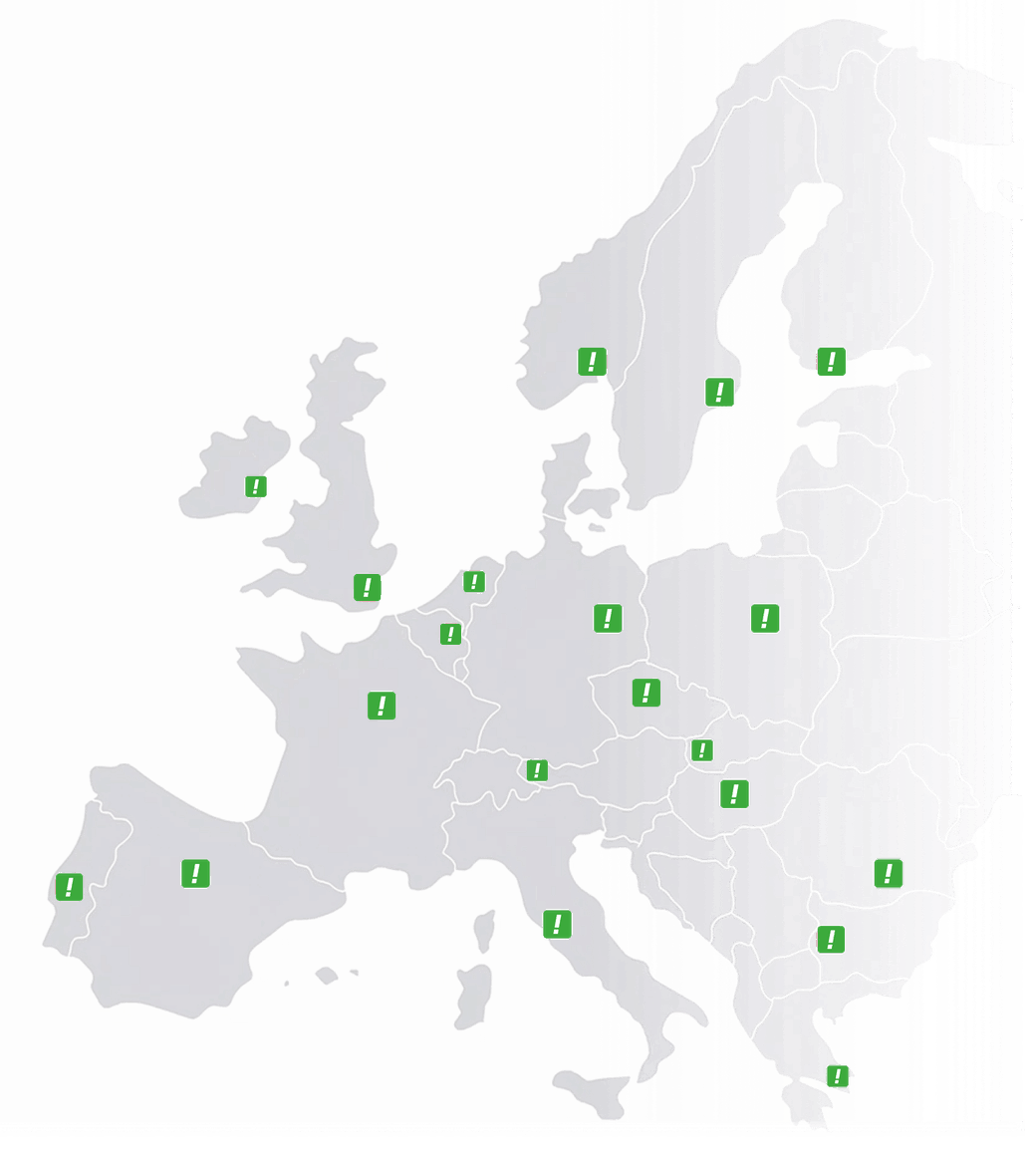
Netherlands
 Belgium
 Denmark
 Germany
 France
 United States
 Austria
 UK
 Spain
 Italy

A voicebot that answers the phone processes personal data from the first second: the caller’s number, what they say and often data the voicebot looks up in your own systems. That means the GDPR applies, just as it does to any employee who answers the same phone. The difference is that an automated system makes some questions sharper: which lawful basis applies, what you must tell the caller, and how long you may keep the conversation?
This article goes through those questions in practical terms, so you can put a voicebot that handles incoming calls on your line without running into a privacy problem later. It covers voicebot GDPR compliance for businesses that receive calls from people in the European Union, and it adds what the EU AI Act requires. It is general information, not legal advice: for your own situation, ask your data protection officer or a lawyer.
Which personal data a voicebot processes
A voicebot processes three kinds of call data.
- Metadata of the call: the number that called, the number that was called, the time and the duration. Your phone system usually logs this anyway.
- The content of the conversation. Speech recognition turns what the caller says into text, so the voicebot can respond and a colleague can read the conversation later. A transcript is as sensitive as an audio recording and needs the same protection.
- Data the voicebot looks up in your CRM, order system or calendar, such as a customer number or an appointment. That links the call to an existing customer profile.
As soon as a caller mentions their health, financial problems or another special category, the call weighs more heavily in your risk assessment, even if the voicebot did not ask for it. A voicebot meant only to confirm appointments can still receive special category data when a caller mentions a medical reason. Build a safety net into the script: when the voicebot recognizes such a signal, it puts the call through to a colleague instead of handling and storing it on its own. Article 9 GDPR sets stricter special category rules for this kind of data.
The lawful basis for processing a call
Every processing operation needs a lawful basis under Article 6 GDPR. For inbound business calls, legitimate interest (Article 6(1)(f)) is often the right basis, because the caller starts the contact and the processing is needed to answer their question. You must be able to show that assessment: why your interest outweighs the caller’s privacy, and which measures you take to protect them. For a voicebot that handles a request from an existing customer, performance of a contract (Article 6(1)(b)) can also apply.
When the call serves a marketing purpose, or when the voicebot processes special category data, explicit consent is the safer route. Record the lawful basis for each call flow in your record of processing activities, so you can show your choice if a data protection authority asks.
What to tell callers at the start of the call
Article 13 GDPR requires you to inform people when you collect their data: who you are, why you process the data, on which basis, how long you keep it and what rights they have. On the phone you cannot read all of that out, so a layered approach works: a short message at the start of the call and the full details in your privacy statement on your website.
The EU AI Act adds a separate duty. Article 50 requires AI systems that interact directly with people to be designed so those people are informed that they are dealing with an AI system, unless that is obvious to a reasonably well-informed person. That obligation applies from 2 August 2026. In practice, one sentence at the start of the call covers both laws, for example: “You are speaking with the digital assistant of [business name]. This call is processed to help you with your question. You can find more information in our privacy statement, or ask for a colleague at any time.”
If the call is recorded, say so as well. Call recording laws also differ outside the EU. In the United States, federal law allows recording with the consent of one party, but several states, California among them, require the consent of everyone on the call. If you receive calls from other countries, check the rules there too.
Where voicebot data may be processed
Processing inside the European Economic Area stays under the same GDPR rules as your own business. When personal data leaves the EEA, Chapter V of the GDPR applies to these international transfers: you need an adequacy decision for the destination country (Article 45) or another valid safeguard, such as standard contractual clauses (Article 46), and you must be able to show that before the first call comes in.
A voicebot is made of several parts: telephony, speech recognition, a language model and speech synthesis. Each part can run with a different company in a different place. Ask your supplier for the data flows of every part and for the list of sub-processors, because each sub processor must be named in your data processing agreement (Article 28) and checked during an audit. A short chain of processors makes that much simpler.
At CallFactory, the telephony, the call routing and the phone system run on our own platform in three data centers in the Netherlands, and call recordings are stored in the EU. We are a licensed operator in 14 European countries and have provided business telephony since 2001, so the telephony part of the chain stays with one company you can name in your records.
How long to keep calls and transcripts
The GDPR sets no fixed retention period. Storage limitation (Article 5(1)(e)) means you keep personal data only as long as the purpose requires. For quality control and handling complaints, a few weeks to a few months is common. For pure routing, such as putting the caller through to the right department, a much shorter period is easy to defend once the call is finished. Record the period for each purpose and make sure deletion happens automatically, so old transcripts do not sit in a forgotten backup.
Data minimization (Article 5(1)(c)) works the same way: let the voicebot ask only for the details it needs to handle the request. A voicebot that books an appointment needs a name and a phone number, not a date of birth.
On our platform, call recordings cover incoming calls only, are kept for up to 30 days by default and are stored in the EU. Only the administrator of your account can listen to them, so decide who that is and keep access controls tight. Read more on call recording.
When a data protection impact assessment is required
Under Article 35 GDPR, a data protection impact assessment (DPIA) is required when processing is likely to result in a high risk for the people involved. For a voicebot, that can be the case with systematic monitoring on a large scale, voice recognition used to uniquely identify callers, processing of special category data on a large scale, or automated decisions without human involvement that have legal or similarly significant effects (Article 22). The European Data Protection Board and the national data protection authorities publish lists of processing that always needs a DPIA.
A voicebot that answers common questions, confirms an appointment or passes doubtful calls to a colleague usually falls outside that obligation. Write the assessment down anyway, so you can show why a DPIA was not needed if someone asks later. If you have a data protection officer, involve them from the start.
What the EU AI Act means for a voicebot
Besides the transparency duty in Article 50, the AI Act sorts AI systems by risk. A voicebot that answers customer questions and routes calls is generally not one of the high risk systems listed in the regulation. That changes when the system is used in areas the AI Act names, such as access to essential services or decisions about credit or employment, so check the use case before go-live. The AI Act does not replace the GDPR: both apply at the same time.
A short checklist before go-live
- Record the lawful basis for each call flow.
- Write a greeting that says the caller is talking to an AI system and points to your privacy statement.
- Make sure callers can always ask for a person.
- Set a retention period for recordings and transcripts, and delete automatically.
- Sign a data processing agreement and check the list of sub-processors.
- Check where each part of the voicebot processes data.
- Decide whether a DPIA is needed, and write down the outcome.
Setting up a voicebot well is about more than scripts and routing rules. A documented lawful basis, honest information for the caller and a clean list of processors decide whether your voicebot holds up when someone asks questions. Handle those three at the start, and GDPR compliance needs little attention afterward. To see how a voicebot fits your calls, read voicebot vs IVR or how much a voicebot costs.