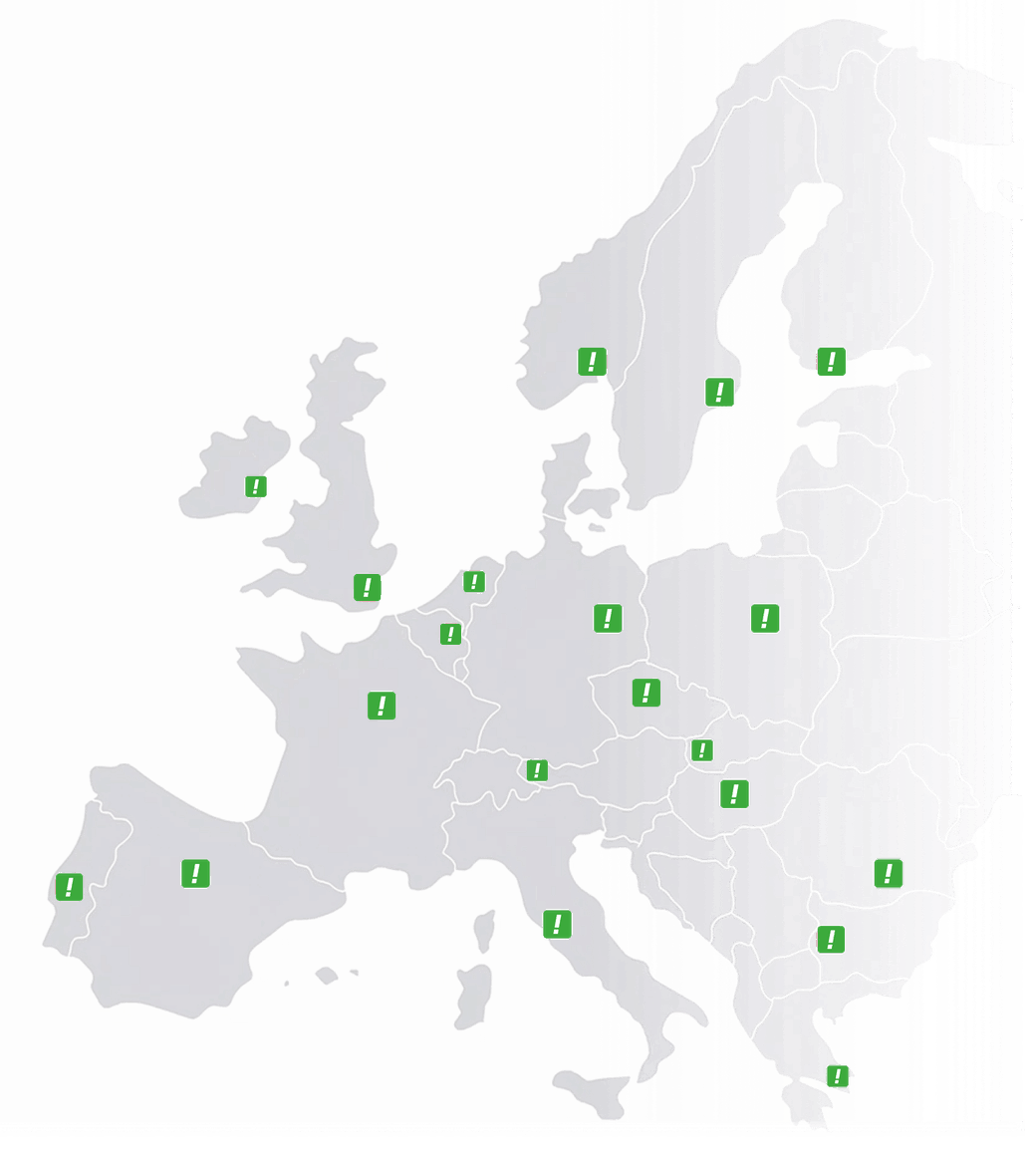
Netherlands
 Belgium
 Denmark
 Germany
 France
 United States
 Austria
 UK
 Spain
 Italy

An emergency line is the number that cannot go unanswered. The patient who calls the doctor on duty at two in the morning, the customer whose heating has stopped in January, the dog owner whose pet is ill on a Sunday: people who call an emergency line are in a hurry, and often worried. Every missed call matters.
That makes it one of the most demanding lines to set up. The hours are long, often 24/7, shifts change, and the person who answers is rarely at a desk. In this article you see how to set up an emergency phone line for your business with an on-call phone line behind it, in five steps, with the examples we see most: medical practices, after-hours doctors’ services, vet clinics, repair and maintenance services and IT support.
One note before we start: a business emergency line does not replace 112, the European emergency number, or 911 in North America. It is for the emergencies your own organization handles directly. Employment rules for on-call work (pay, rest periods, maximum shifts) are set by law and labor agreements in each country; here we only cover the phone side: how the call reaches the person on duty.
Step 1: choose the number for your emergency line
The phone number of your emergency line is the part you will not change again. You print it on your website, the door of the practice, service contracts and the voicemail greeting. You can choose between:
- A local number with the area code of your city, such as 020 Amsterdam or 030 Berlin. Callers recognize a number from their own region, and it can be called from abroad too.
- A national number, such as a Dutch 085 number, which is not tied to one city. Useful if your service covers a whole region or several offices.
- A toll-free number, free for the caller, which suits a toll-free service line for customers in one country. Keep in mind that a toll-free number can usually only be called from inside its own country, so a customer traveling abroad may not reach it.
Do you already have an emergency line that patients or customers know? With number porting you move it to us for free, in at most five business days, and it keeps working during the move. A new healthcare or emergency line is usually live within hours; a regular business number is active within one business day.
Step 2: organize on-call shifts and availability
The central question of every on-call service is simple: who answers when it rings, and who answers if that person is busy?
With an on-call line the business phone number always stays the same, while the shifts behind it change freely. In the team dashboard whoever starts a shift sets themselves available and whoever finishes sets themselves away. The next call follows that choice. A last-minute shift swap on a Saturday evening needs no change to any call forwarding: one colleague signs out, the other signs in.
All colleagues can see the rota through a private link, so everyone knows when it is their turn. If you prefer to plan shifts weeks ahead, use calendar-based call routing, where you set who is on duty for each day and hour. It costs extra on top of your plan: ask us for the price.
The person on duty answers wherever they are, so you need no new telephone equipment. The call arrives on their mobile as a normal phone call, over the mobile network and not over the internet, so no app needs to be open and no Wi-Fi is needed. That is how business calls on your mobile work. With call forwarding you can also send calls to a landline, an office phone or the business phone system you already have, so your existing phone equipment keeps working. No internet connection is needed for calls to a mobile.
Step 3: set up the welcome message
Callers should know at once that they have reached the right number. A short, clear welcome message reassures them, for example:
“You have reached the evening and weekend service of Riverside Medical Practice. We are connecting you to the doctor on duty.”
You can record the message yourself or create it with our text-to-speech assistant, which has more than 99 voices, national and international. When you change the text in the dashboard, callers hear the new message from the next call. For a breakdown line, a message about an ongoing outage also helps: callers hear the information, and your colleagues stay free for new reports.
With a whisper message the person who answers also knows at once that the call comes from the emergency line, before they are connected, even if the caller ID shows an unknown number. The caller does not hear it. That helps when one person on duty takes business calls from several numbers.
Step 4: decide what happens if nobody answers
In an emergency, a caller who hears a busy signal or an endless ringing tone hangs up and may not try again. The doctor on duty is on the phone with another patient, the technician is under a boiler: an on-call service needs a plan B too. With escalation, if the person on duty does not answer within the time you set, the call moves to the next person in the chain: a second doctor, a backup technician, the owner.
You choose the order and how long each phone rings. Calls can ring one after another, always starting with the first person, in turn (round robin) or on all phones at once. One piece of advice we give every customer: keep at least one mobile in the chain, first or last, so there is always someone reachable away from the office.
As the final destination, when really nobody answers, the call can go to voicemail: the message arrives by email as an audio file and stays in the dashboard for 90 days.
Step 5: check and improve your emergency line
The work is not done on the day the line goes live. Call statistics show incoming and missed calls, and you also receive them by email every day and every week. Missed calls are the most important figure for an emergency line: if you see missed calls on Saturday mornings, add a person to that shift or a backup destination.
With call recording you can check what was said in a difficult call and use real examples to train colleagues. Recordings of incoming calls are kept up to 30 days by default, are stored in the EU and only the account administrator can listen to them. Check the call recording laws that apply before you switch it on.
Which businesses use an on-call line
The setups we build most often:
- Medical practices and after-hours doctors’ services. Next to the practice number, an emergency line that goes to the doctor on duty outside business hours. See also our page for healthcare providers.
- Vet clinics. A night and weekend emergency line, which can be shared by several clinics in a region.
- Midwives, home care and pharmacies. Shifts that change every week or every day, with one number for patients and clients.
- Repair, maintenance and IT services. The breakdown line in a service contract, where the call goes to the technician on call that week, even in the van.
Healthcare is our specialist industry, and medical and semi-medical customers such as vets are our core market. In the Netherlands, where we started in 2001, our numbers have been used for medical emergency lines for many years. Leiden University Medical Center (LUMC) runs several emergency and blood transfusion lines on our platform, and its staff change themselves which doctor is on call, also on weekends. Bie Bijen runs a veterinary emergency line shared by several Dutch clinics.
On-call line, answering service or virtual receptionist?
Businesses that need to be reachable outside business hours often compare three options for their emergency calls. An answering service is a team of external operators who answer your calls and take a message; the caller does not speak to your own staff. An on-call line connects the caller straight to your own colleague on duty, so the person who answers can help right away. A virtual receptionist is our AI voicebot, which we set up for you: it answers the call, finds out what the caller needs and connects them to the right person or team.
For emergencies, the on-call line is usually the best fit, because urgent callers want to reach someone who can act. An answering service suits small businesses that mainly need messages taken, but in an emergency a message is often not enough: the caller needs the doctor, the vet or the technician. A voicebot can sit in front of it for routine questions, such as opening hours, so the person on duty only gets the calls that need them.
What an on-call line costs
An on-call line already works with the Phone System plan, €25 a month or €250 a year for up to 2 people, with a welcome message, business hours and the team dashboard. For a larger rota, a phone menu, a call queue and call recording, choose Customer Service, €49 a month or €490 a year for up to 8 people; for more people we make a custom plan. On local and national numbers in the 14 European countries where we are licensed, forwarded calls to mobiles and landlines are included with normal use; toll-free numbers, numbers in other countries and forwarding abroad have their own per-minute rate, on request. Setting up the phone system is free, and for a line with several departments or locations we prepare it together with you. See the on-call service and pricing.
And if one night something does not work as expected, our support mailbox is monitored 24 hours a day, for every customer on the same platform.