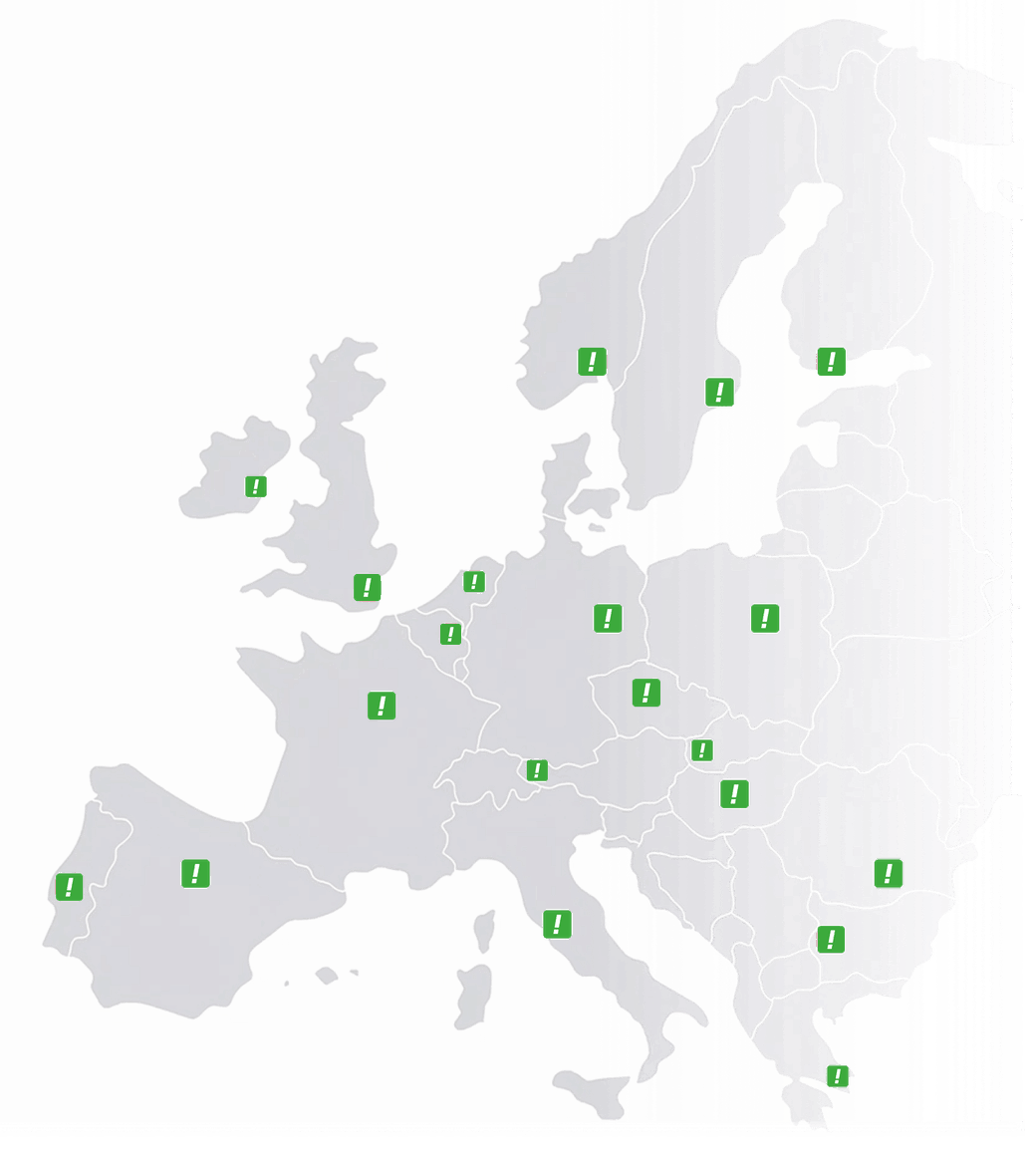
Netherlands
 Belgium
 Denmark
 Germany
 France
 United States
 Austria
 UK
 Spain
 Italy

Call recording laws decide whether you may record a phone call, and the answer depends on where you and the other party are. In the United States, federal law and most states allow recording if one party on the call consents, while about a dozen states require the consent of everyone on the call. In the European Union and the United Kingdom, a business that records calls processes personal data, so GDPR or UK GDPR applies. Recording a conversation you are not part of is a crime almost everywhere.
This article explains the main recording laws, with sources, and what a business does in practice before it starts recording calls. It is general information, not legal advice: for your own case, ask a lawyer or your data protection officer (DPO).
Call recording laws in the United States
Federal laws: one-party consent
The federal Wiretap Act, part of the Electronic Communications Privacy Act, allows a person to record a phone call or an in-person conversation if they are a party to it or if one party has given consent. The rule is in 18 U.S.C. § 2511(2)(d). This is called one-party consent: only one party needs to agree, and that party can be the person recording.
The federal exception has a limit. A recording made for a criminal or tortious purpose is not covered, even with one party’s consent. Recording telephone calls between other people, where you are not a party and nobody on the call consents, is wiretapping under federal law.
One-party consent states
Most states follow the federal rule. In a one-party consent state, an employee who takes part in a call may record it without telling the other party, as long as the recording is not made for an illegal purpose. New York, Texas and Georgia are examples of one-party consent states.
Two-party consent states and all-party consent
A smaller group of states requires the consent of all parties to a private conversation. These are usually called two-party consent states, although “all-party consent” is more accurate, because with three people on a conference call all three must agree. The Digital Media Law Project lists California, Connecticut, Florida, Illinois, Maryland, Massachusetts, Montana, New Hampshire, Pennsylvania and Washington. It also notes that its guide is no longer updated, and some states have special rules (Massachusetts, for example, bans secret recording), so check the current state law before you rely on a list.
In most all-party consent states it is enough that every party knows the call is recorded and continues the call. That is why so many businesses play a short notice at the start of inbound calls. California’s Penal Code section 632 is the best-known example: it protects “confidential communications”, where a party has a reasonable expectation of privacy, and a recording notice removes that expectation.
Calls across state lines
Recording calls between two states is where call recording laws get difficult. If the business is in a one-party consent state and the caller is in California, it is not always clear which law applies, and courts have applied the stricter state’s law. The practical rule for businesses is simple: if your callers may be in several states, treat every call as an all-party consent call and inform the caller at the start.
Recording phone calls in Europe: GDPR
In the EU, the question “is it legal to record phone calls” has two parts. Criminal law protects private conversations against people who are not part of them, and some countries go further: in Germany, section 201 of the Criminal Code makes it an offense to record the privately spoken word of another person without consent, even as a participant. In Italy, by contrast, the Supreme Court has held that a participant who records a call is not intercepting it.
For a business, the second part matters most. A call recording contains personal data (the caller’s voice, name and often more), so the General Data Protection Regulation ( GDPR, Regulation (EU) 2016/679) applies. In short, GDPR asks for:
- A clear purpose. For example quality control, training, handling complaints or proof of orders and agreements made by phone.
- A legal basis under article 6. Often the business’s legitimate interest, weighed against the caller’s rights; in some sectors a legal obligation. Explicit consent is one basis, but not the only one.
- Information for the caller under article 13: who records, why, for how long and what rights the caller has. A notice at the start of the call, with a link to the full privacy notice on your website, is the usual way.
- Data minimization and storage limitation. Record only what you need and keep recordings no longer than the purpose requires.
- Security and limited access. Only the people who need the recordings can listen to them.
National data protection authorities add their own guidance, and recording employees’ calls can bring in labor law as well, for example rules on monitoring staff at work. Before you record the calls of a team, involve your DPO and, where the law requires it, the works council or employee representatives.
If an AI voicebot answers your calls, the EU AI Act adds a transparency rule: under article 50, people who talk to an AI system must be told that they are talking to a machine, unless that is obvious. Our article on voicebots and GDPR covers the data protection side.
Call recording in the United Kingdom
The UK applies UK GDPR and the Data Protection Act 2018 in much the same way as the EU applies GDPR. An individual may generally record a call they take part in for their own use. A business that records calls needs a lawful basis, must tell callers and must handle the recordings as personal data. Financial firms regulated by the Financial Conduct Authority have their own rules that require them to record certain calls.
Outbound calls and inbound calls
Call recording laws apply in both directions. For inbound calls, the welcome message is the natural place for the notice. For outbound calls, the person making the call has to say it, because there is no greeting before the conversation starts. If you record only inbound calls, as we do, you only need the notice on your incoming numbers.
When recording becomes a legal risk
Recording a call you take part in is legal in most places, with the right notice. These situations carry legal risk:
- Recording other people’s conversations. If you are not a party and nobody on the call consents, you are intercepting the call, which is a crime under federal and state law and in European countries.
- Recording without notice in an all-party consent state. This can lead to a civil lawsuit and, in some states, criminal penalties.
- Sharing or publishing a recording. Even a lawful recording does not mean you may share it freely. Under GDPR you need a legal basis for every use, and publishing a call can lead to fines and claims for damages.
- Keeping recordings forever. Without a retention limit you keep personal data longer than the purpose needs, which GDPR does not allow.
A lawful recording can serve as evidence in a dispute, but how a court treats it depends on the country and the case.
How to record calls in your business the right way
With call recording from CallFactory, the recording happens on our network, not on a phone. Nobody needs a recording app on their mobile, and it works for every phone in the team: mobile, landline or desk phone. Some parts we handle, others are up to you.
What we do:
- We record inbound calls on your CallFactory number; outbound calls are not recorded.
- We store recordings in the EU.
- We keep them up to 30 days by default; longer storage is a paid option.
- Only the account administrator listens to recordings, not everyone who logs in to the dashboard. They play them in the browser, download them as audio files or retrieve them through the API.
- After each recorded call we make a transcript, which you find next to the recording.
What you do:
- Decide on which numbers to record, for example the sales line but not the internal line.
- Inform callers with a notice in the welcome message, which you can create with the text-to-speech assistant. For example: “Thank you for calling Miller Installations. Calls may be recorded for quality and training. You can read our privacy notice on our website.”
- Prepare your privacy notice and, if you record your employees’ calls, check the labor law rules in your country.
- Download and archive in your own system only the recordings you must keep longer.
Call recording is part of the Customer Service plan, at €49 a month or €490 a year for up to 8 people, together with the phone menu (IVR) and the call queue. On local and national numbers in the 14 European countries where we are licensed, calls are included with normal use; above that, calls cost €0.10 per minute, and those 10 cents include recording, transcription and logging if you want them. See pricing for the details.
Summary
Under US federal law and in most states, a call may be recorded with one party’s consent; in all-party consent states everyone must know. In the EU and the UK, a business that records calls follows GDPR or UK GDPR: a clear purpose, a legal basis, a notice to the caller and a limited retention period. Recording other people’s conversations is illegal almost everywhere. For your own situation, ask a lawyer or your DPO.