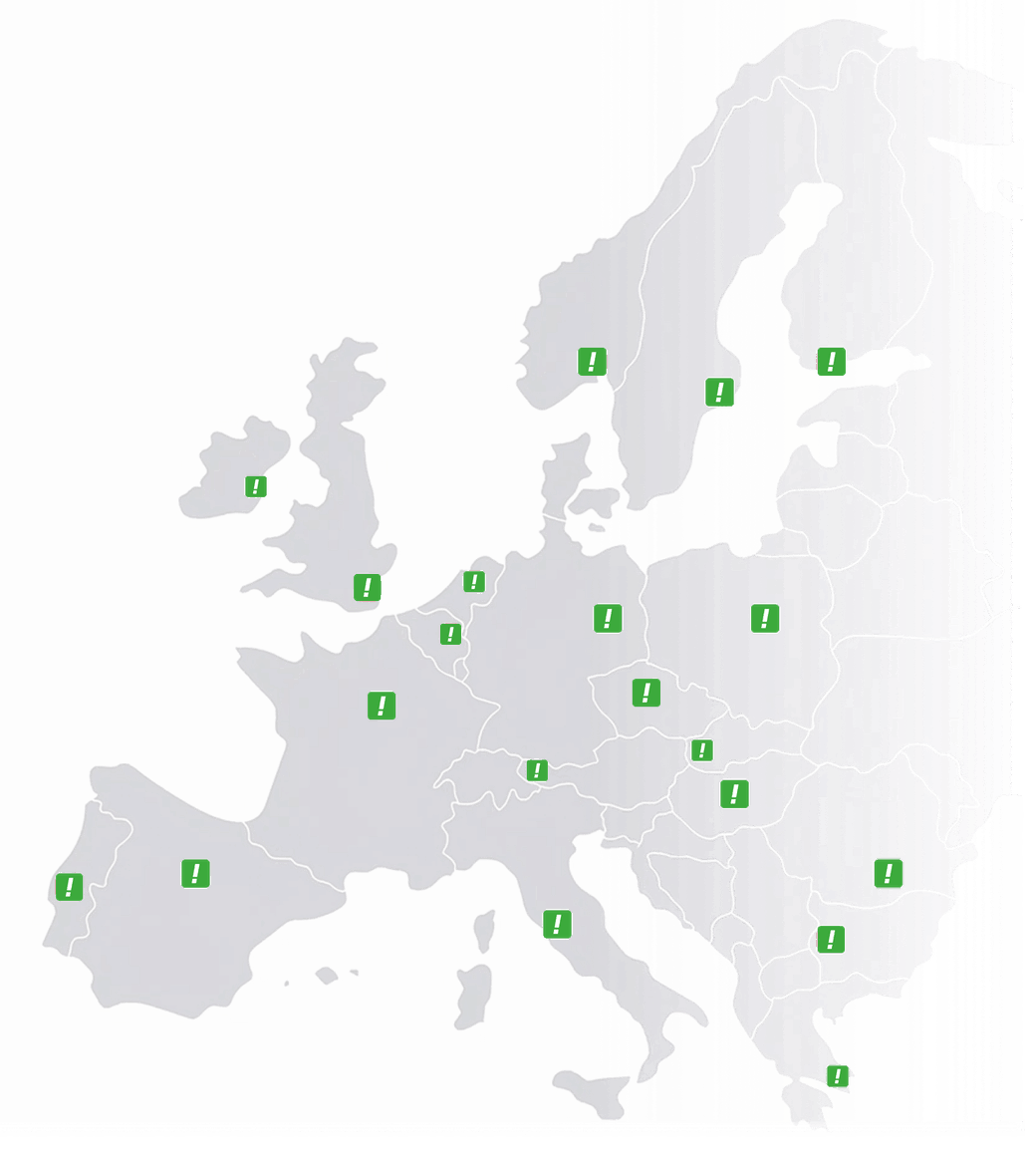
Netherlands
 Belgium
 Denmark
 Germany
 France
 United States
 Austria
 UK
 Spain
 Italy

Call forwarding is one of the oldest features on a phone, and still one of the most useful. The office line goes to whoever is on call after closing time, a sales rep takes over the reception line while traveling, or a colleague covers your calls while you are with a client. With one code on your phone, your carrier sends every incoming call on to another phone number.
This guide is written for two kinds of reader:
- You want to forward calls on your own mobile or landline. Below you find the call forwarding codes for GSM mobiles in Europe and elsewhere, the most common US codes, and how a forwarded call is charged. You don’t need any extra service for that.
- You want to forward a business number for your company or team. Then go to call forwarding with a business number. There we explain how forwarding works on our platform, what it costs and what you get on top of a code on one handset.
How call forwarding works
When call forwarding is on, your carrier’s network receives the incoming call for your number and connects it to a different number you chose: a colleague’s mobile, the office landline or your voicemail. The caller dials your number as usual and doesn’t notice the forwarding. Your own phone either doesn’t ring at all, or it rings first and passes the call on when you can’t answer.
There are two main types:
- Unconditional forwarding (forward all calls): every call goes straight to the forwarding number. Useful when you are out of the office for a day or on vacation.
- Conditional forwarding: a call is only sent on in a specific situation. When you don’t answer (no-answer forwarding), when the line is busy (busy forward), or when your phone is unreachable because it is off or has no signal.
Most people use conditional forwarding for daily work, because their own phone still rings first.
Call forwarding in your phone’s settings
The simplest way to forward calls is in the phone app or call settings of your handset.
iPhone: open Settings, tap Phone (or Apps, then Phone on newer versions) and choose Call Forwarding. Switch it on and enter the forwarding number. You switch it off with the same toggle. The iPhone menu only offers forwarding of all calls; for the conditional types use the codes below.
Android: open the phone app, tap the three dots and choose Settings. Look for Calls, Supplementary services or Call forwarding (on a Samsung phone usually under Supplementary services), then choose the situation and enter the number. The exact menu names vary by brand and Android version.
Some carriers in the United States don’t offer the iPhone toggle at all; then you use the code on your phone’s dialer.
GSM call forwarding codes (Europe and most of the world)
These forwarding codes follow the GSM standard, so they work on most mobile networks in Europe, the UK and many other countries. Replace number with the phone number you want to forward to, preferably in international format (for example +31 6 for a Dutch mobile), and press the call button after the code. Your phone shows a status message when the setting is active.
| Situation | Activate | Deactivate | Check status |
|---|---|---|---|
| All calls (unconditional) | **21*number# | ##21# | *#21# |
| When you don’t answer | **61*number# | ##61# | *#61# |
| When your phone is unreachable | **62*number# | ##62# | *#62# |
| When your line is busy | **67*number# | ##67# | *#67# |
| All conditional types at once | **004*number# | ##004# | |
| Everything off in one go | ##002# |
With no-answer forwarding, many networks let you set how many seconds your phone rings first: **61*number**seconds#, where seconds is 5 to 30 in steps of 5. Not every carrier supports this, so check the status afterwards.
Call forwarding codes in the United States
US codes vary by carrier, by plan and by line type, which is why the same code can work on one phone and fail on the next. These are the most common ones. Check your carrier’s help pages if a code does not work.
- Landlines (most US providers): dial
*72, then the forwarding number, to forward all calls. Wait for the person at the other number to answer or for a confirmation tone. Dial*73to cancel. Many providers also offer no-answer forwarding with*92(cancel with*93). - Verizon mobiles:
*72plus the number forwards all calls,*71plus the number forwards calls only when you don’t answer or the line is busy, and*73turns forwarding off. - AT&T mobiles: AT&T uses GSM codes, such as
*21*number#to forward all calls and#21#to cancel.##002#switches every type off. - T-Mobile mobiles:
**21*number#forwards all calls,##21#cancels and##002#removes every forwarding setting.
Some carriers charge for call forwarding as a feature, or only include it on certain plans. Long distance or international forwarding can cost extra, see the next section.
What call forwarding costs on your own phone
Switching forwarding on is free with most large carriers. What you pay for is the forwarded leg of the call: your carrier charges it as if you were calling the forwarding number yourself.
- Landline. The forwarded part of the call is charged at the rate of your calling plan. On a plan with included minutes it usually comes out of that bundle; to a long distance number it can cost more.
- Mobile. On most plans a forwarded call uses your included minutes, like a normal outgoing call. Once your bundle is used up, or if you forward to a number outside it, standard charges apply.
- Abroad. Forwarding to a number in another country is charged at international rates. If forwarding is on while you are roaming, your carrier may also charge roaming rates for the forwarded leg.
So the cost is not in the code but in your plan. If you forward calls every day, check what the forwarded minutes add up to.
Call forwarding with a business number
A CallFactory business number works on the same principle as forwarding on your phone. Someone calls your number, and we forward the call to your current phone numbers, your phone system, or both. Calls to a mobile or landline travel over the fixed and mobile phone network, like an ordinary call, so they reach you on the road without Wi-Fi or mobile data. No app has to run.
The difference is everything around it. Forwarding on a phone is a setting on one number that you switch on and off with a code. On our platform, forwarding is part of a system built to route calls:
- Several destinations. Phones ring one after another, in turn (round robin) or all at once, with a fallback if nobody answers.
- Forwarding rules you change live. In the dashboard you change where calls go, for every number, from anywhere. The next call follows the new setting.
- Availability per person. In the team dashboard each colleague sets themselves available or not, so calls don’t ring on the phone of someone on leave.
- Opening hours and holidays. Outside business hours callers hear a closed message and can leave a voicemail. For planned shifts there is calendar-based routing, which costs extra; ask us for the price.
- Voicemail by email. If nobody answers, the caller leaves a message that reaches you as an audio file by email and stays 90 days in the dashboard.
- A whisper message. A short whisper tone tells you it is a business call before you speak, so you answer with your company name.
- Outgoing calls with your business number. From the softphone your outgoing calls show the business number, not your private mobile.
- A voicebot as a destination. Outside business hours or at peak times, our AI voicebot answers every caller, handles routine questions and connects callers to a person when needed.
Read everything that is possible on our call forwarding page.
What forwarding costs with a CallFactory number
On local and national numbers in the 14 European countries where we are licensed, forwarding to a mobile or landline is included with normal use. If you call more as a matter of course, you pay €0.10 per minute to mobiles and landlines alike, billed per second with no connection fee, and that includes call recording, transcription and logging if you want them.
Toll-free numbers, numbers in other countries (the United States included) and forwarding to a phone abroad have their own per-minute rate, on request. A US phone number with a local area code or an 800 prefix, forwarded to your phone in Europe, is a common example: your US callers make a domestic call, and we quote the forwarding rate with the number.
The plans: Business Number at €149 a year for one person, with call forwarding, welcome message and voicemail. Phone System at €25 a month for up to two people, with ring order, opening hours and a holiday calendar. Customer Service at €49 a month for up to eight people, with a phone menu, call queue and call recording. A number in any other country is €49 a month with every Customer Service feature, or a €250-a-year market test. All details are on the pricing page. Prices exclude VAT where it applies.
When the code on your phone is enough
If you only forward calls now and then, the code on your phone is all you need. A day at a trade fair with a colleague covering your mobile: **21*number# in the morning and ##002# afterwards will do.
A business number makes sense when you forward calls every day, when several people or locations share the phone (the office, remote workers and a branch), or when your reachability should not depend on a setting on one handset. Your personal number stays personal, you control everything from one dashboard, and a new number is active within one business day. If you already have a business number, you can port it to us free of charge.