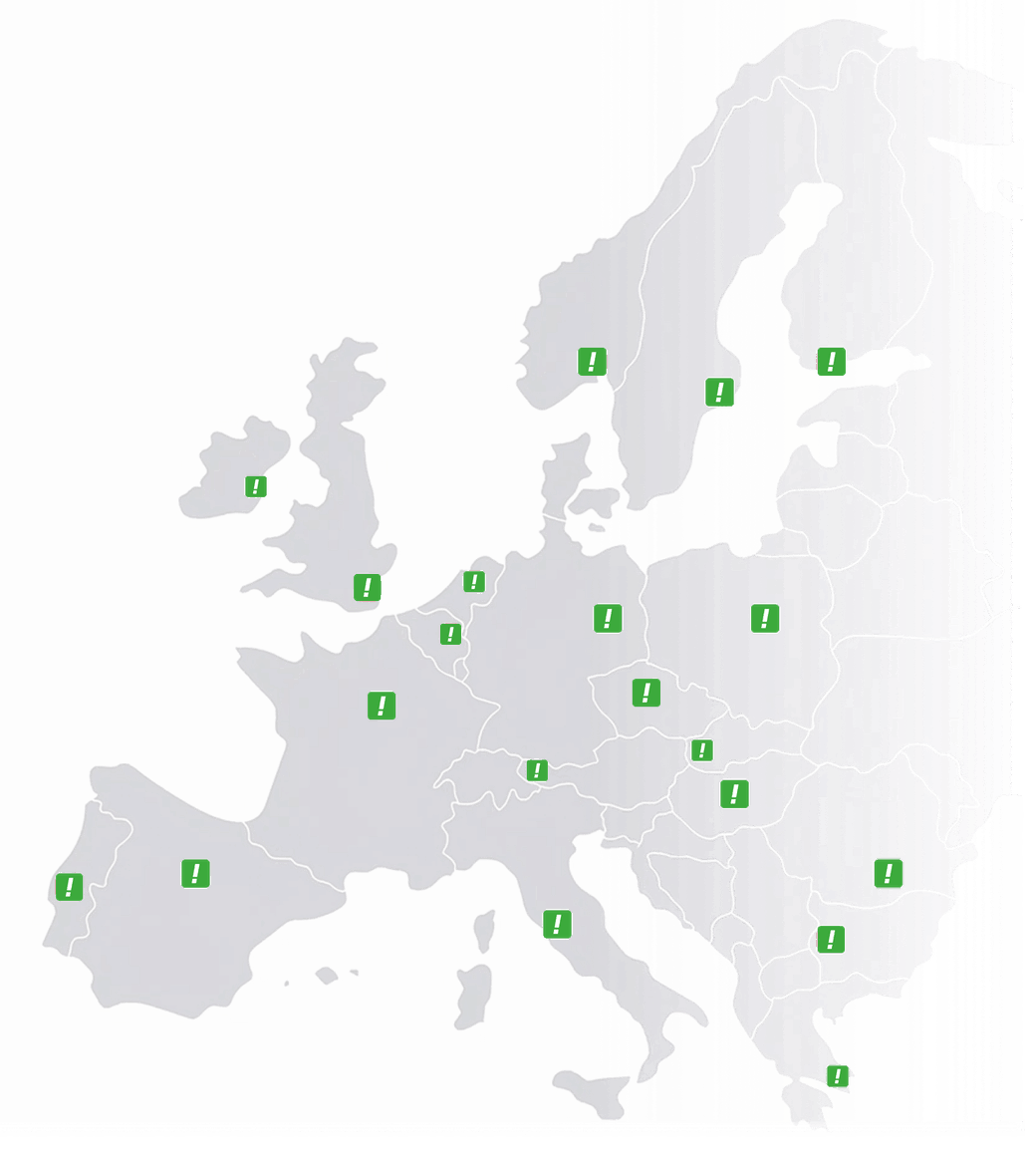
Netherlands
 Belgium
 Denmark
 Germany
 France
 United States
 Austria
 UK
 Spain
 Italy

Anyone who has bought software knows the model: you pay per user per month. For the seller it is attractive, because every new colleague at every customer adds revenue without extra cost behind it. The model has spread to business telephony, so the cost of a business phone system is now often a price per user.
That the model works for the seller does not mean it suits telephony. This article explains what really drives the cost of a business phone system, why per user pricing fits telephony poorly, and why we charge per plan, with calls included with normal use. What each plan costs is on our pricing page.
Why per user phone system pricing is so popular in business phone systems
For software, a price per user makes sense. Every user has their own account, their own data and their own license. For the seller, revenue grows automatically with every customer that grows, which makes it one of the most profitable models there is.
Now imagine your internet connection were billed per device in the building, so a new printer or an extra laptop raised your monthly bill. Nobody would find that logical, because the cost of an internet connection comes from its use, not from the number of devices. Telephony works the same way.
What really drives business phone system cost
Traditional phone systems used to be sold per system and per number of phone lines. The number of lines decided how many calls could take place at the same time, and that is what you paid for. Nobody counted how many handsets were in the building, because it made no difference to the cost.
That logic still holds. Whether five or fifteen handsets are connected to a number, the number of calls coming in does not change. What changes is the number of minutes, and that is where the real cost sits.
Networks settle with each other per minute
Phone networks charge each other per minute, not per person. When a call passes from one network to another, the networks charge each other an interconnection rate per minute. In Europe these rates are regulated, so that networks do not overcharge each other.
That settlement applies to all traffic, incoming and outgoing. Even when a customer calls your number, the call has to be delivered to us by the network the customer calls from. If you forward the call to a mobile, we pay the network that delivers it to your phone. Every call you receive costs money per minute, however many users are on your system.
As a licensed operator in 14 European countries with our own interconnections, we work with minutes as the unit ourselves. Because an ordinary business makes relatively few calls, we include those minutes in your plan with normal use, instead of charging you per person.
Desk phones at reception, in the warehouse and in the meeting room
A price per user assumes every phone belongs to one person. In an ordinary business that is rarely the case. There is a handset at reception, one in the kitchen, one in the warehouse and one in the meeting room. If the phone rings while someone walks past, that person answers, even though they are not a user on the system.
With a price per user you have to choose for each of those handsets: pay for a user who is not a person, or leave the handset out and miss calls. With us, shared handsets never count toward your plan, and the number of logins is unlimited. The calls that come in on them are part of your plan.
Who keeps track of the users?
Large organizations have an IT department that creates and removes accounts. Small businesses usually have no administrator. Someone sets up the number today, and when that person moves to another role next year, nobody knows exactly who is on the system.
In practice a new administrator adds users but rarely removes anyone, because disconnecting feels risky. The number of paid users creeps up, while the number of people who actually take calls stays the same. With a price per plan that problem does not arise: an extra name on the system does not change your monthly bill.
Toll-free numbers do not fit the per user model at all
On a toll-free number you pay for the call instead of the caller. The cost depends entirely on how many minutes customers spend calling you, and not at all on how many people answer. A price per user cannot even be attached to it, which shows that the model comes from software rather than from telephony. Toll-free numbers therefore have their own per-minute rate, which depends on the country, and you get it on request before you order.
Business phone system cost with us: per plan, calls included
We do know users, but we group them into plans:
- Business Number: €149 a year for one person, with an extra year free on your first purchase.
- Phone System: €25 a month or €250 a year, for up to two people.
- Customer Service: €49 a month or €490 a year, for up to eight people, with a phone menu, a call queue and call recording.
Adding or removing a colleague within your plan does not change your bill, and shared handsets are free. For more than eight people we put together a custom plan. A number takes up to 50 team members and 50 simultaneous calls, so a busy support team fits on one number. Prices are in euros and exclude VAT where it applies, and every plan can be tried free for 7 days.
On local and national numbers in the 14 European countries where we are licensed, calls are included with normal use. That covers forwarding to a mobile or landline, outgoing calls with your business number and calls answered over the internet. Your plan also covers the capacity to take several calls at once and the phone system itself: routing, opening hours, voicemail and the dashboard. There is no separate charge for lines or platform fees.
A number in another country, such as a US local number, is €49 a month (€490 a year) with every Customer Service feature, or €250 a year as a market test with one line. These numbers, toll-free numbers and forwarding abroad have their own per-minute rate, on request. They are always delivered over the fixed or mobile phone network, never over the internet.
Setup costs and ongoing costs of a business phone system
When you compare the cost of a business phone system, look beyond the monthly price. With us, setting up the phone system is free, also for a phone menu with several teams or calendar rules. Porting your existing phone numbers is free and takes at most five business days, and your number keeps working with your current provider until the move is complete.
Desk phones are optional. Calls can ring on the mobile phones and landlines your team already has, so you do not need to purchase desk phones. If you want a VoIP phone system at the office, you buy SIP desk phones from your IT supplier or a general online store and connect them, or you use a softphone on a computer. Calls answered over the internet on a local or national number in the 14 European countries where we are licensed are included with normal use.
The ongoing costs are the plan, and minutes only above normal use. For international calling, the per-minute rate depends on the destination country, and you get it on request.
What if your team makes a lot of calls?
If your team is on the phone a lot, a price per user with unlimited calling is not the answer either, because a fair use policy usually applies there too. With us you pay €0.10 per minute above normal use, to mobiles and landlines alike, billed per second with no connection fee. Those 10 cents also cover call recording, transcription and logging of the call if you want them. If you would rather not depend on normal use at all, you can choose to pay per minute from the start at the same rate.
Either way, you keep the benefits of a plan. Calls are delivered over the fixed and mobile phone networks, so the phone still rings if your office internet goes down, and you never have to count users. When your team grows, you keep the same number and the same dashboard, and only the features of your plan change.